
5 May 2020
There are estimated to be around 400 species of Australian fauna that use tree hollows. Sadly, natural tree hollows are declining due to the pressures of urbanisation and land clearing.
You can provide a supplementary hollow and help protect wildlife in your area by installing a nest box.
How to build and install a nest box
Download our handy guide to Building and Installing a Nest Box and you’ll have a nest box up and little visitors making themselves at home in no time!
Who can you expect to visit?
Many species of frogs, reptiles, birds and mammals will utilise nest boxes. In Queensland, these can include the following species (this list is not exhaustive):
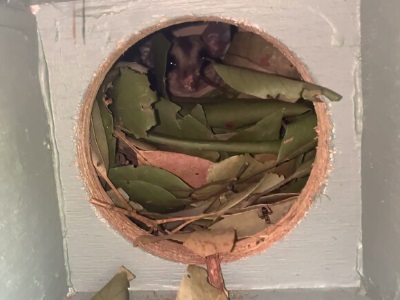
Squirrel glider is very comfy in this nest box. image © Alan Howieson.
- Brushtail possum
- Ringtail possum
- Striped possum
- Feathertail glider
- Greater glider
- Mahogany glider
- Squirrel glider
- Sugar glider
- Yellow-bellied glider
- Yellow-footed antechinus
- Insectivorous bats
- Barn owl
- Pale-headed and eastern rosellas
- Crimson rosella
- Galah
- King parrot
- Rainbow lorikeet
- Scaly-breasted lorikeet
- Pardalote
- Kookaburra
- Black cockatoo
- Little treecreeper
- Masked owl
- Owlet-nightjar
- Fletcher’s frog
- Green tree frog
- Brown tree snake
- Stephen’s banded snake
- Green tree python
- Rusty monitor
- Lace monitor
Alan, who to date has built and installed 6 nest boxes on his property, said the nest box was actually for a kookaburra but is now home to a glider (see pic above).
“I have 2 other boxes with gliders in them too (different designs as these are meant for pale-headed rosellas and lorikeets). I’m more than happy to have gliders in them though. I think I need to make more boxes!”
Have you built a nest box?
We’d love to see your creations and the wildlife that inhabits them. Share your images and nest box adventures with us on Facebook or Instagram.
For information about Wildlife Queensland’s glider nest box projects and how you can support your local glider populations, visit our Queensland Glider Network page.
More Wildlife Blogs

Stage One eDNA sampling complete for South East Queensland’s Resilient Rivers Project
Wildlife Queensland has completed Stage One of the Resilient Rivers eDNA survey led by Dr Tam Brunt, sampling 246 sites to build a regional picture of aquatic biodiversity.

Greater gliders in focus as Wildlife Queensland expands conservation research
Wildlife Queensland is taking a closer look at how greater gliders live, glide and shelter across two forest sites to better protect this endangered species.

Wildlife Queensland wins Australian Quarry Life Award for Richmond birdwing butterfly recovery
The Richmond birdwing butterfly (Ornithoptera richmondia) is one of Queensland’s most recognisable native species and depends on two vines, the birdwing butterfly vine (Aristolochia praevenosa) and mountain aristolochia (A. laheyana), for its survival. Habitat loss has pushed this butterfly into decline across much of its range, and it is now listed as vulnerable.